×

UPSC Courses

DNA banner

DAILY NEWS ANALYSIS

  • 11 April, 2021

  • 5 Min Read

Tika Utsav to begin on Jyotirao Phule’s Birth Anniversary

Tika Utsav to begin on Jyotirao Phule’s Birth Anniversary

  • The 'Tika Utsav (vaccination festival)', started on the birth anniversary of Mahatma Jyotirao Phule (11th April) will continue till the birth anniversary of Babasaheb Ambedkar on 14th April 2021.
  • The aim of the four day festival is to vaccinate as many people as possible for the priority groups and zero wastage of Covid-19 vaccine.
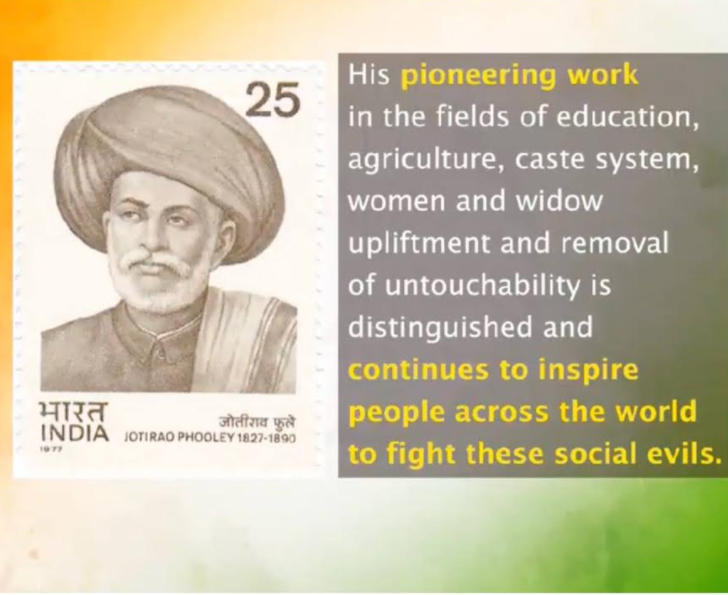
  • Jyotirao Phule was an Indian social activist, thinker, anti-caste social reformer and writer from Maharashtra. He is also known as Jyotiba Phule.

https://www.drishtiias.com/images/uploads/1618227925_image6.png

Profile

  • Phule was born on 11th April 1827 in present-day Maharashtra and belonged to the Mali caste of gardeners and vegetable farmers.
  • In 1841, Phule was enrolled at the Scottish Missionary High School (Pune), where he completed his education.

Ideology

  • His Ideology was based on Liberty; Egalitarianism; Socialism.
  • Phule was influenced by Thomas Paine’s book titled "The Rights of Man" and believed that the only solution to combat the social evils was the enlightenment of women and members of the lower castes.
  • Major Publications: Tritiya Ratna (1855); Powada: Chatrapati Shivajiraje Bhosle Yancha (1869); Gulamgiri (1873), Shetkarayacha Aasud (1881).
  • Related Association: Phule along with his followers formed Satyashodhak Samaj in 1873 which meant ‘Seekers of Truth’ in order to attain equal social and economic benefits for the lower castes in Maharashtra.
  • He was appointed commissioner to the Poona municipality and served in the position until 1883.
  • He was bestowed with the title of Mahatma on 11th May, 1888 by a Maharashtrian social activist Vithalrao Krishnaji Vandekar.

Social Reformer

  • In 1848, he taught his wife (Savitribai) how to read and write, after which the couple opened the first indigenously run school for girls in Pune where they both taught.
  • He was a believer in gender equality and he exemplified his beliefs by involving his wife in all his social reform activities.
  • By 1852, the Phules had established three schools but all of them had shut by 1858 due to the shortage of funds after the Revolt of 1857.
  • Jyotiba realised the pathetic conditions of widows and established an ashram for young widows and eventually became an advocate of the idea of Widow Remarriage.
  • Jyotirao attacked the orthodox Brahmins and other upper castes and termed them as "hypocrites".
  • In 1868, Jyotirao constructed a common bathing tank outside his house to exhibit his embracing attitude towards all human beings and wished to dine with everyone, regardless of their caste.
  • He started awareness campaigns that ultimately inspired the likes of Dr. B.R. Ambedkar and Mahatma Gandhi, stalwarts who undertook major initiatives against caste discrimination later.
  • It is believed by many that it was Phule who first used the term ‘Dalit’ for the depiction of oppressed masses often placed outside the ‘varna system’.
  • He worked for the abolishment of untouchability and the caste system in Maharashtra.
  • 28th November 1890. His memorial is built in Phule Wada, Pune, Maharashtra.

Source: PIB


Anti-Defection Law in India

The Supreme Court of India recently gave a final three-week deadline to the Telangana Assembly Speaker to decide pending disqualification petitions against defecting MLAs under the Anti-Defection Law. What is the Anti-Defection Law? The Anti-Defection Law was introduced through the 52nd Amendment (1985), which added the Tenth Schedule to the

Rat-Hole Mining

A major disaster unfolded in East Jaintia Hills, Meghalaya, when at least 18 workers died following an explosion in an illegally operating rat-hole coal mine. This incident highlights the continued prevalence of rat-hole mining despite bans imposed by the National Green Tribunal (NGT) and the Supreme Court of India. Rat-hole mining is driven

India’s Aviation Sector

India’s aviation sector has grown rapidly, becoming a major economic success story. However, regulatory oversight has not evolved at the same pace. Data-driven monitoring of fares and market behavior is essential to ensure fair competition, prevent market abuse, and shift from reactive crisis management to proactive regulation. Challen

Federalism in India

Recently, a high-level committee on Union–State relations submitted its first report to the Government of Tamil Nadu. The report examines the distribution of powers and responsibilities between the Union and the States, highlighting ongoing debates regarding the balance between central authority and state autonomy. This discussion is clos

India–UAE Economic Partnership

The relationship between India and the United Arab Emirates has evolved from a traditional energy-based partnership into a comprehensive economic and strategic relationship. Over the years, strong political trust, growing trade, and expanding investments have transformed bilateral ties into a diversified economic corridor. The economic partnership

DNA

22 Mar,2026

Toppers

Search By Date

Newsletter Subscription
SMS Alerts

Important Links

UPSC GS Mains Crash Course - RAW