Online Learning Portal
Online Learning Portal

Hybrid Classes
We provide offline, online and recorded lectures in the same amount.

Personalised Mentoring
Every aspirant is unique and the mentoring is customised according to the strengths and weaknesses of the aspirant

Topicwise Mindmaps
In every Lecture. Director Sir will provide conceptual understanding with around 800 Mindmaps.

Quality Content
We provide you the best and Comprehensive content which comes directly or indirectly in UPSC Exam.

DAILY NEWS ANALYSIS
 PRINT
PRINT
02 February, 2024
6 Min Read
River dolphins are a group of freshwater cetaceans that inhabit various river systems across Asia and South America. The Six Surviving River Dolphin Species include: Amazon, Ganges, Indus, Irrawaddy, Tucuxi, and the Yangtze finless porpoise.The Chinese river dolphin was deemed 'probably extinct' in 2007.
As per the IUCN Red list, Yangtze finless porpoise are classified as Critically Endangered.Amazon, Ganges, Indus, Irrawaddy and Tucuxi are labeled as Endangered.
Note: The Yangtze finless porpoise is the world’s only freshwater porpoise but it is included with the other freshwater cetaceans under the umbrella name ‘river dolphins’.
The Amazon river dolphin also known as the pink river dolphin or boto is the largest river dolphin.
About Gangetic River dolphin
The Ganges river dolphin was officially discovered in 1801.They were declared as the National Aquatic Animal of India in 2009.
Freshwater species:The Gangetic river dolphin is one of the four freshwater dolphin species in the world.
The other three are the baiji, now likely extinct from the Yangtze River in China, the bhulan of the Indus in Pakistan and the boto of the Amazon River in Latin America.
Habitat:
Characteristics:
Different names:
They are also known as Susu, Hihu, Blind dolphin, Ganga river dolphin, side swimming dolphin and South Asian river dolphin.
They hunt by emitting ultrasonic sounds, which bounces off of fish and other prey, enabling them to see an image in their mind.
IUCN Status: Ganges river dolphins are listed as Endangered in the IUCN Red List.
Environmental significance
Threats
|
Katarnia wildlife sanctuary
|
Global Declaration for River Dolphins
Recently, 11 Asian and South American countries signed a landmark deal in Bogota, Colombia to save the world’s six surviving species of river dolphins from extinction.This landmark deal signifies a ray of hope in combating the severe decline of river dolphin populations, which have dwindled by a staggering 73% since the 1980s.
Global Declaration for River Dolphins?
The Global Declaration for River Dolphins aims to halt the decline of all river dolphin species and bolster the most vulnerable populations through concerted efforts.It outlines measures such as eradicating gillnets, reducing pollution, expanding research initiatives, and creating protected areas to safeguard the remaining river dolphin species.
Countries that adopted the declaration include: Bangladesh, Bolivia, Brazil, Cambodia, Colombia, Ecuador, India, Nepal, Pakistan, Peru, and Venezuela.
There was also a representative from the regional government in Indonesia that has responsibility for the Mahakam river.
Foundational Pillars:
Challenges Faced by River Dolphins:
River dolphins are threatened by diverse factors, including unsustainable fishing practices, hydropower dam construction, pollutionfrom various industries, agriculture, and mining, as well as habitat loss.Also, the recent tragic deaths of over 150 river dolphins in the drought-stricken Lake Tefe in the Amazon illustrate how climate change poses an increasingly severe threat to their survival.
Successful Conservation Efforts:
Conservation efforts in populated river basins like the Indus and Yangtze have seen success.
Moreover, the World Wildlife Fund's electronic pinger project saved 80 dolphins in Indonesia's Mahakam river from gill net entanglement.
Source: worldwildlife

 03 Dec, 25
On 1st November, eight Indian states—Andhra Pradesh, Chhattisgarh, Haryana, Karnataka, Kerala, Madhya Pradesh, Punjab, and Tamil Nadu—along with five Union Territories—Andaman and Nicobar Islands, Chandigarh, Delhi, Lakshadweep, and Puducherry—celebrate their Formation Day. This date marks an important milestone in India
 02 Dec, 25
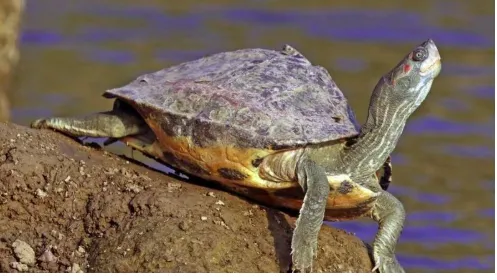
The Turtle Wildlife Sanctuary, also known as the Kachhua Sanctuary, is located in the Varanasi district of Uttar Pradesh. It is recognised as India’s first freshwater turtle wildlife sanctuary, established to conserve endangered turtle species and support the ecological health of the Ganga River. Location and Extent The sanctuary co
 02 Dec, 25
The Ministry of Education plans to introduce Artificial Intelligence (AI) and Computational Thinking (CT) from Class 3 onwards in the 2026–27 academic year. This initiative is part of the National Curriculum Framework for School Education (NCF-SE) 2023 and aligns with the National Education Policy (NEP) 2020. The aim is to prepare student
 02 Dec, 25
Scientists from the Environment Department of Himachal Pradesh University (HPU) in Shimla have recently revealed that the Sal tree (Shorea robusta) is the most effective natural air purifier for combating rising pollution levels. Their findings highlight the tree’s superior capacity to trap dust, absorb gases, and cleanse the air compared
 02 Dec, 25
The President of the United States has ordered the resumption of nuclear weapon testing after a gap of 33 years, the last test being in 1992. This decision marks a significant shift in global nuclear policy and has far-reaching implications for geopolitics, the environment, and international security. Status of Global Nuclear Weapon Testing
 03 Dec,2025










Our Popular Courses
Module wise Prelims Batches
Mains Batches
Test Series

 24 × 7 Support :
8287714422
24 × 7 Support :
8287714422 Whatsapp :
8010068998
Whatsapp :
8010068998 Email Us: query@aspireias.com


 My Notes
 Geography And Environment


